
AI Systems and Operations
Before AI Can Run the Work, the Organization Has to Make the Work Legible
UiPath Cartographer aims to capture the rules, exceptions, judgment, and ownership behind real processes. That is the context AI systems need before they can automate work reliably.
Many organizations have documented less of their work than they think.
There may be policies, process diagrams, training materials, spreadsheets, and standard operating procedures. But the process people actually follow often lives somewhere else: in judgment, exceptions, workarounds, message threads, and the experience of employees who know what to do when the manual no longer applies.
UiPath’s new Cartographer product is an attempt to capture that missing layer.
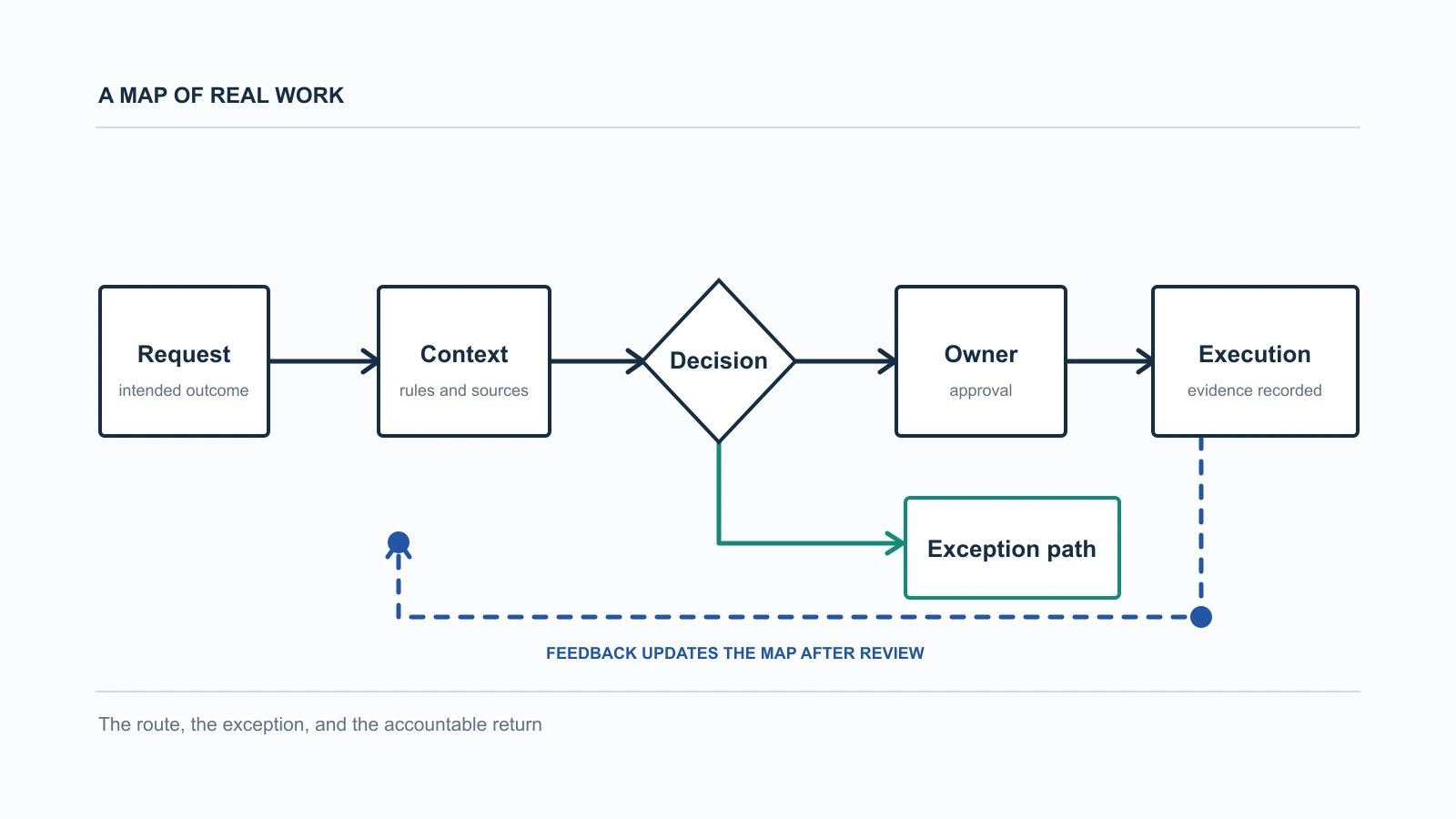
The company calls the result a “Map of Work”—a living, customer-owned representation of how a process runs. UiPath says Cartographer can synthesize documents, steps, rules, exceptions, and expert input; produce design documents and build-ready specifications; and maintain a Decision Ledger recording what was decided and why. Proposed changes return to a named owner for approval rather than silently rewriting the process.
The announcement points to a constraint on agentic automation: an organization may not have made its work legible enough for a model—or a new employee—to execute reliably.
Trace the work that actually happens
An ordinary process map describes the intended path. Reliable automation also needs to understand:
- which outcomes the process is meant to produce;
- where the authoritative information lives;
- which rules are fixed and which require judgment;
- what exceptions occur;
- who may approve a deviation;
- how evidence is recorded;
- what happens when the expected path fails.
Without that context, an agent can complete a task while weakening the larger system.
This is why “add AI” is rarely a sufficient implementation plan. The work has to be traced before it can be delegated responsibly. Hidden handoffs, contradictory rules, stale documents, unclear ownership, and undocumented exceptions become automation defects.
Cartographer’s design reflects a more mature view: operating knowledge should improve while the process runs. When people correct the system or make a judgment call, that learning can return as a proposed update. If the owner approves it, the operating map becomes more accurate for the next cycle.
That creates the possibility of compounding institutional knowledge.
It also creates an important governance question. A map of real work will contain operationally sensitive knowledge: how decisions are made, where exceptions exist, which systems connect, and what failure modes matter. Ownership, identity, permissions, provenance, and change control are not secondary features. They are part of whether the map can be trusted.
UiPath says Cartographer inherits its platform’s identity, security, and governance controls. The company separately announced Data Fabric, MCP connectivity, runtime checking, model visibility, compliance packs, and identity-and-access policies. Those are UiPath’s descriptions of its product architecture, and organizations will need to verify how the controls work in their own environment.
Make the map useful before automating
The broader lesson does not depend on buying this product. Before automating an important workflow, build a truthful representation of the work.
Start with one process. Identify the intended outcome. Follow the real path, not merely the documented one. Record the systems, decisions, exceptions, owners, evidence, and escalation points. Find the places where people compensate for a broken design through memory or heroics.
Then decide what software should execute, what it should recommend, and where human judgment must return.
When context is explicit and ownership is clear, agents can act with less ambiguity. New employees learn faster. Failures are easier to diagnose. Improvements can accumulate instead of disappearing inside one person’s experience.
The quality of the automation will depend on the honesty of that map.
Sources
- UiPath’s Cartographer announcement, September 23, 2026.
- UiPath’s platform update, September 23, 2026.